
Complete Guide to Stem Cell Hair Loss Treatment in Korea: Activating Follicle Regeneration from the Root
Hair loss is a concern that affects countless people worldwide. Whether it’s a receding hairline or thinning at the crown, every strand lost takes a toll on our confidence. Traditional treatments — medications and hair transplants — are effective but have limitations. In recent years, Korea’s aesthetic medicine industry has pioneered the application of stem cell technology for hair loss treatment, opening an entirely new path to hair regeneration. Unlike hair transplants that simply “relocate” follicles, stem cell therapy fundamentally activates the regenerative capacity of existing follicles, bringing dormant follicles back to life.
This guide covers the root causes of hair loss, explains how stem cell scalp injections work, the treatment process, suitable candidates, and expected results.
1. Root Causes of Hair Loss: What’s Happening to Your Follicles?
To understand how stem cells treat hair loss, we first need to understand the fundamental mechanisms. Hair growth depends on follicles — tiny organs located in the scalp’s dermal layer. Each follicle has its own growth cycle: anagen (growth phase, 2-6 years), catagen (regression phase, 2-3 weeks), and telogen (resting phase, 3-4 months). Normally, about 85-90% of follicles are in the growth phase. However, when follicles are affected by various internal and external factors, this precise cycle breaks down.
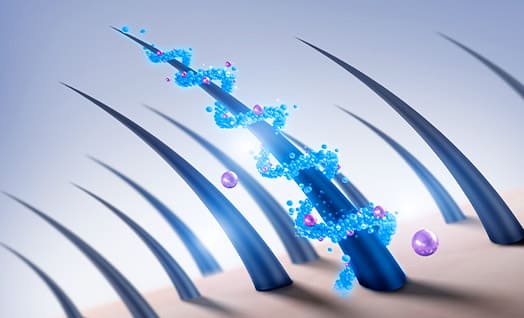
Follicle Shrinkage and Miniaturization
Follicle shrinkage is the core pathological change in hair loss. Healthy follicles are like fertile soil that nurtures thick hair. Under various influences, follicles gradually “shrink” — from producing thick terminal hair to only growing fine vellus hair, eventually losing the ability to produce hair entirely. This process is called “follicle miniaturization” and is the common endpoint of most types of hair loss.
DHT (Dihydrotestosterone) Damage
In androgenetic alopecia (also known as hereditary or pattern hair loss), DHT is the primary culprit. Testosterone is converted to DHT by 5-alpha reductase, and when DHT binds to androgen receptors in follicles, it shortens the growth phase and accelerates follicle miniaturization. Follicles in the frontal and crown areas are particularly sensitive to DHT, explaining why male pattern baldness always starts in these regions.
Poor Scalp Blood Circulation
Follicle nutrition depends entirely on the scalp’s microcirculation system. When scalp blood circulation is poor, follicles enter a state of “nutritional starvation,” the growth phase shortens, and hair becomes thinner and softer before eventually falling out. Chronic stress, poor lifestyle habits, and scalp inflammation can all lead to microcirculation disorders.
Follicle Stem Cell Dysfunction
Follicles contain special stem cells — follicle stem cells — located in the bulge region, serving as the “seeds” for cyclical hair regeneration. With aging and increased oxidative stress, these stem cells decrease in number and activity, unable to effectively initiate new growth cycles. Research shows that while follicle stem cells still exist in balding areas, they are in a “dormant” state. This discovery provides the theoretical foundation for stem cell therapy.
2. How Stem Cells Treat Hair Loss: Fundamentally Improving the Follicle Environment
The core principle of stem cell scalp injection therapy is to inject concentrated preparations rich in hematopoietic and mesenchymal stem cells directly into the scalp’s follicular region, repairing and rebuilding the growth environment from multiple dimensions. This isn’t simply “supplementing nutrition” — it activates the follicle’s self-repair and regeneration mechanisms at the cellular level.
Follicle Cell Regeneration
Stem cells injected into the scalp can differentiate into various cells needed by follicles, including dermal papilla cells, matrix cells, and outer root sheath cells. More importantly, growth factors secreted by stem cells (VEGF, FGF, IGF-1, HGF, etc.) can “awaken” dormant follicle stem cells and restart the hair growth cycle.
Strengthening Hair Roots and Dermal Papilla
The dermal papilla is the follicle’s “command center,” controlling hair growth rate and thickness. Stem cell injection increases dermal papilla cell numbers and activity, restoring normal regulation of the follicle growth cycle. Simultaneously, stem cells promote collagen and elastin synthesis around hair roots, reinforcing the hair’s “foundation.”
Improving Scalp Microcirculation
VEGF (Vascular Endothelial Growth Factor) secreted by stem cells promotes the growth and repair of scalp capillaries, significantly improving blood supply around follicles. Clinical observations show that after stem cell treatment, scalp examinations reveal markedly increased vascular density around follicles.
3. Suitable Types of Hair Loss
Stem cell scalp injection is not a one-size-fits-all solution. Here are the main types of hair loss it effectively treats:
Androgenetic Alopecia (AGA): The most common type, accounting for over 95% of all cases. Best results for Norwood stages II-IV (men) and Ludwig stages I-II (women).
Alopecia Areata: An autoimmune condition where stem cells help modulate immune responses and reduce attacks on follicles.
Postpartum Hair Loss: Stem cell injection accelerates the transition from telogen to anagen phase, shortening recovery time.
Stress-Related Hair Loss: Stem cells improve the follicle microenvironment and restore normal growth rhythm.
Scarring Alopecia: Stem cells can activate residual follicles at scar margins and improve scar tissue.
4. Treatment Process
Korea’s stem cell hair loss treatment follows a standardized protocol with strict specifications at every step.
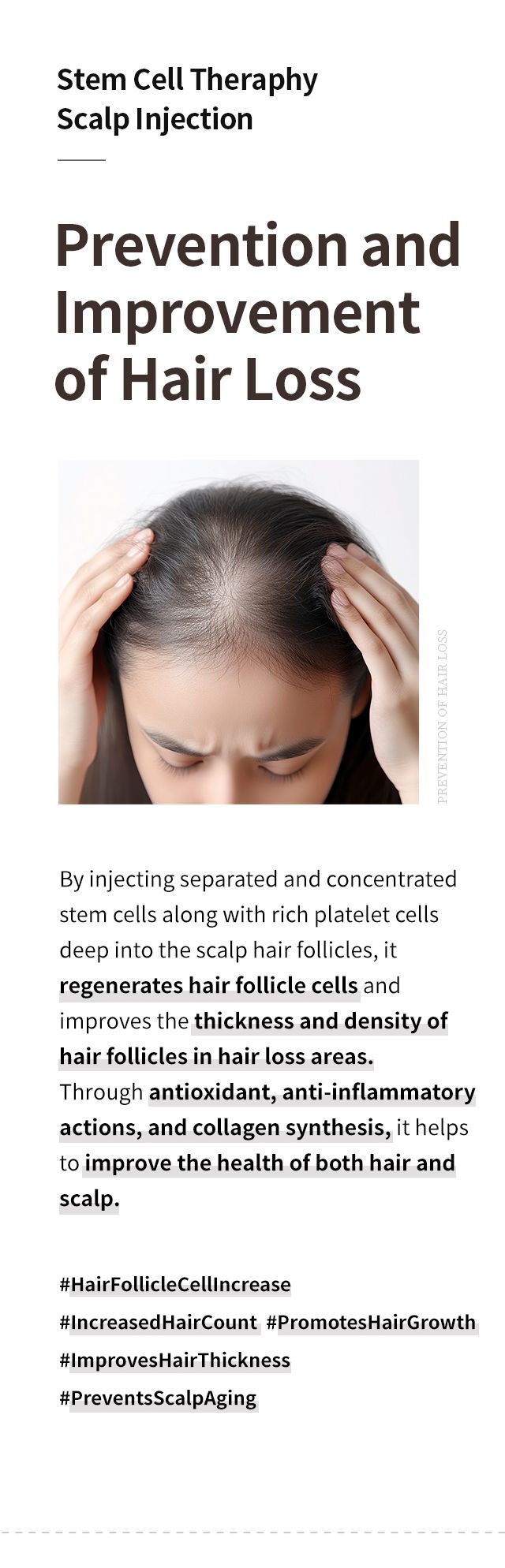
Step 1: Professional Scalp Assessment (30-60 min) — Comprehensive evaluation using specialized instruments including follicle density measurement, hair thickness analysis, and scalp health assessment.
Step 2: Stem Cell Preparation — Depending on the treatment plan, stem cells may be derived from the patient’s own blood (most common), adipose tissue, or umbilical cord blood.
Step 3: Scalp Preparation & Anesthesia (15-20 min) — The treatment area is cleaned and topical or local anesthesia is applied.
Step 4: Precision Injection (30-60 min) — Using micro-needles or specialized injection devices, the stem cell preparation is precisely injected into the scalp’s dermal layer at a depth of 1-3mm.
Step 5: Post-Treatment Care (15-30 min) — Cold compress application to reduce swelling, followed by detailed aftercare instructions.
5. Treatment Schedule & Results Timeline
A standard course consists of 3-6 sessions: mild hair loss requires 3-4 sessions (3-4 weeks apart), moderate requires 4-6 sessions (2-4 weeks apart), and severe may need 6+ sessions with intensive initial treatment.
Results Timeline:
- 1-2 weeks: Improved scalp condition, reduced oiliness
- 1-2 months: Noticeably reduced hair loss
- 2-3 months: New fine hairs begin appearing
- 3-6 months: New hair becomes thicker and darker, visible density improvement
- 6-12 months: Results stabilize, continued quality improvement
6. Stem Cell Treatment vs Hair Transplant
| Comparison | Stem Cell Injection | Hair Transplant |
|---|---|---|
| Principle | Activates existing follicle regeneration | Relocates follicles from donor area |
| Surgery | Non-surgical, micro-injection | Surgical procedure |
| Recovery | No downtime | 1-2 weeks swelling, 3-6 months shedding phase |
| Sessions | 3-6 per course | Usually one surgery |
| Best for | Early to mid-stage hair loss | Mid to late-stage, requires sufficient donor area |
| Cost | ₩100-300K per session, ₩400-1500K per course | ₩500-2000K depending on grafts |
| Scarring | None | FUE micro-scars / FUT linear scar |
Key difference: Transplants “relocate” limited donor follicles; stem cells “renovate” existing follicles from the root. Both approaches complement each other well.
7. Combination Treatments for Enhanced Results
In clinical practice, stem cell scalp injection is often combined with other treatments: stem cells + hair transplant (improves graft survival by 15-20%), stem cells + PRP (synergistic growth factor effects), stem cells + low-level laser therapy (LLLT), stem cells + medications (finasteride/minoxidil), and stem cells + microneedling.
8. Pre & Post-Treatment Guidelines
Before treatment: Stop anticoagulants one week prior, avoid alcohol for 3 days, wash hair on treatment day without styling products.
After treatment: Avoid washing hair for 24 hours, no intense exercise or sauna for 48 hours, no hair coloring or perming for one week. Mild redness and slight swelling typically resolve within 2-3 days.
9. Practical Tips for Treatment in Korea
Korea offers C-3-3 medical tourism visas for overseas patients. BeautsGo can assist with visa applications (approximately $85 USD), provide Chinese-language interpreter services, arrange transportation, and handle accommodation bookings to ensure a smooth treatment journey.
10. Frequently Asked Questions
Q: Is the treatment painful? After local anesthesia, most patients report only mild pressure. Pain is far less than hair transplant surgery.
Q: Can stem cells completely cure hair loss? Results depend on individual factors. For early to mid-stage hair loss where follicles haven’t fully closed, significant improvement is achievable. Maintenance treatments every 3-6 months are recommended.
Q: Are there side effects? Common mild reactions include injection site redness and minor bruising, which resolve within 2-3 days. Autologous stem cells carry no rejection risk.
Q: My crown is completely bald — will it still work? If follicles are completely closed (typically bald for 5-10+ years), results will be limited. A professional follicle assessment is recommended first; hair transplant may be needed before stem cell treatment.
Q: Can women get stem cell hair treatment? Absolutely. Women with diffuse thinning are ideal candidates as their follicles typically don’t fully close. It’s also more female-friendly than transplants — no shaving required, no scarring, quick recovery.
Final Thoughts
The key to hair loss treatment is early detection and early action. Once follicles die completely, even the best technology cannot bring them back. Stem cell scalp injection offers a non-surgical, regenerative approach to hair restoration, and Korea leads the world in stem cell research and clinical application.
If you’re interested in stem cell hair loss treatment, contact our professional consultants via WeChat, LINE, or our Mini Program for a free scalp assessment and treatment plan.
Contact Us for a Free Consultation
Connect with our professional consultants for personalized plans and cost estimates


LINE

Mini Program