 BeautsGo
For receding hair at the temples or an uneven hairline, hair transplantation is usually the first option to assess. Forehead reduction may be considered when the existing hairline is dense, the forehead is vertically long and the scalp has enough mobility. A transplant moves follicles from a donor area into areas needing coverage. Forehead reduction advances the existing hair-bearing scalp. Wanting a hairline two centimetres lower is not enough, on its own, to choose either operation.
1. Is the concern forehead height, receding hair at the temples or ongoing hair loss?
A high central hairline is different from an M-shaped hairline caused by recession at the temples. One concerns vertical proportions; the other concerns shape and coverage at the sides. If shedding has increased, the part is widening or the back of the scalp is also thinning, investigate the cause before choosing surgery.
| Main concern | Approach to discuss | Essential assessment |
|---|---|---|
| Receding hair at the temples or an uneven hairline at the sides | Hair transplantation, with separate planning for the centre and temples | Donor hair quality, area needing coverage and hair direction |
| A vertically long forehead with a dense existing hairline | Forehead reduction to advance the hair-bearing scalp | Scalp mobility, incision placement, scarring and hair-loss risks |
| A high hairline with a widening part or thinning crown | Assess the hair loss before deciding on surgery | Whether the donor area is affected and whether hair loss is stable |
| A high forehead with low brows and upper-eyelid heaviness | Assess forehead height and brow position separately | Forehead reduction is not a brow lift; combined surgery is not automatically necessary |
Hair transplantation needs healthy donor hair and a suitable recipient area. The cause of hair loss may also need investigation. A naturally high forehead is not a disease, and changing it is a personal choice: there is no single ideal forehead proportion for everyone.
2. The two operations change different things
Hairline transplantation: adding coverage and refining the outline
The surgeon harvests follicular units from a suitable donor area and places them along the frontal hairline and temples. Planning involves fine hairs at the edge, growth direction and a gradual transition into existing hair—not just drawing a lower line. Using too much of a limited donor supply to create a very low hairline may reduce coverage elsewhere and limit future options.
FUE (individual follicular unit excision) and FUT (strip harvesting) describe donor-harvesting techniques, not two ways of surgically shortening the forehead. FUE leaves small, scattered donor scars; FUT usually leaves a linear donor scar. Neither is scar-free or non-invasive. Unshaven, partially shaved and long-hair techniques are separate considerations. An unshaven procedure alone does not determine final density or naturalness.
Forehead reduction: moving the existing hairline, not adding follicles
An incision is made along the hairline. The hair-bearing scalp is mobilised and advanced, a strip of forehead skin is removed, and the tissues are secured and sutured. The possible advancement depends on scalp mobility, tissue tension and previous surgery. Tissue should not be pulled excessively just to reach a target measurement. The hairline position changes early, but swelling and scar healing still take time.
A systematic review of eight retrospective studies reported an average reduction of about 1.6 cm. This group average is not a promise for an individual patient. Reported complications included scarring, hair loss, persistent altered sensation and haematoma.
3. MOMO and MOJELIM: comparing women’s hairline transplantation
MOMO Plastic Surgery: choosing the harvesting method and designing the hairline
MOMO Plastic Surgery has a women’s centre offering hairline design, scar coverage and postoperative care, with both FUT and FUE options. If the central hairline is already at a suitable height but the temples need filling, planning should identify the frontal and lateral areas needing coverage rather than simply lowering the whole line.
Choosing between FUE and FUT involves donor supply, hair length, the number of hairs required and acceptable donor scarring. Both cases below involved 3,000 hairs, but different harvesting methods. Equal hair counts do not mean equal coverage, and these two patients’ photos cannot establish which method is better. Ask why the proposed method fits your donor area and how the new edge will blend with existing hair.
MOMO case 1: FUE, 3,000 hairs, 352 days after surgery
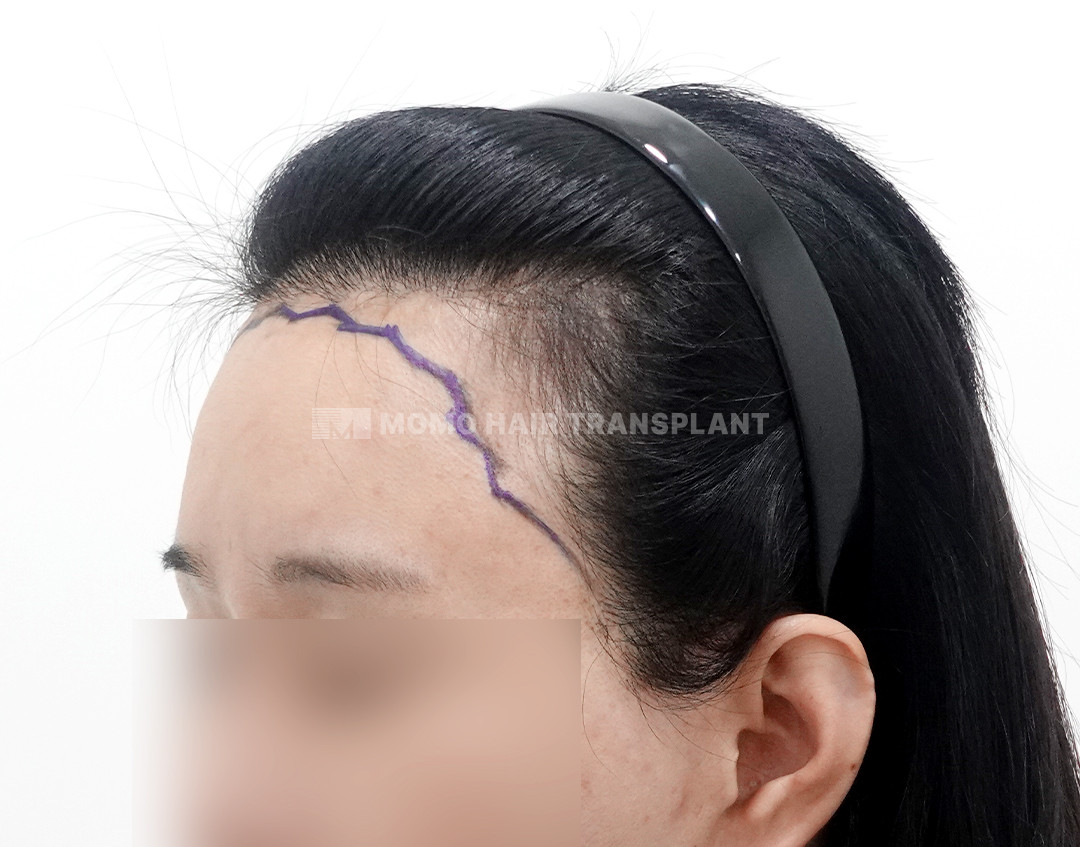 Before surgery
 352 days after surgery
MOMO case 2: FUT, 3,000 hairs, 378 days after surgery
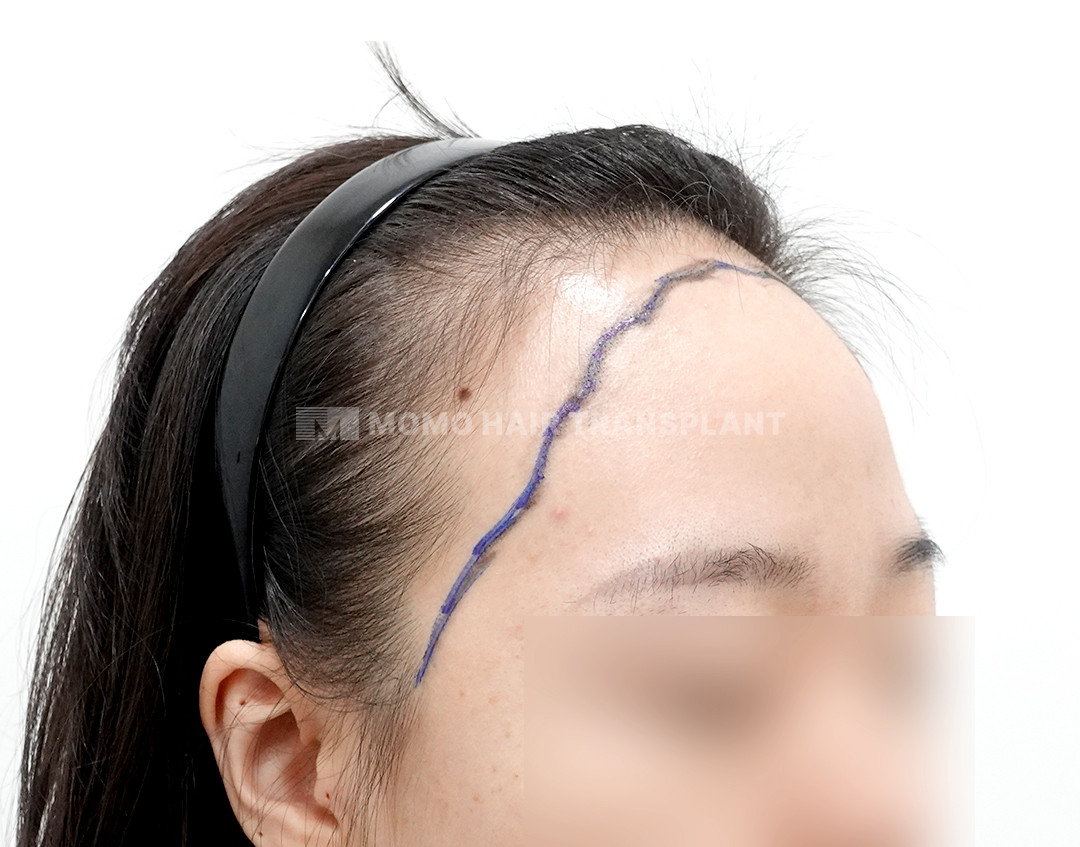 Before surgery
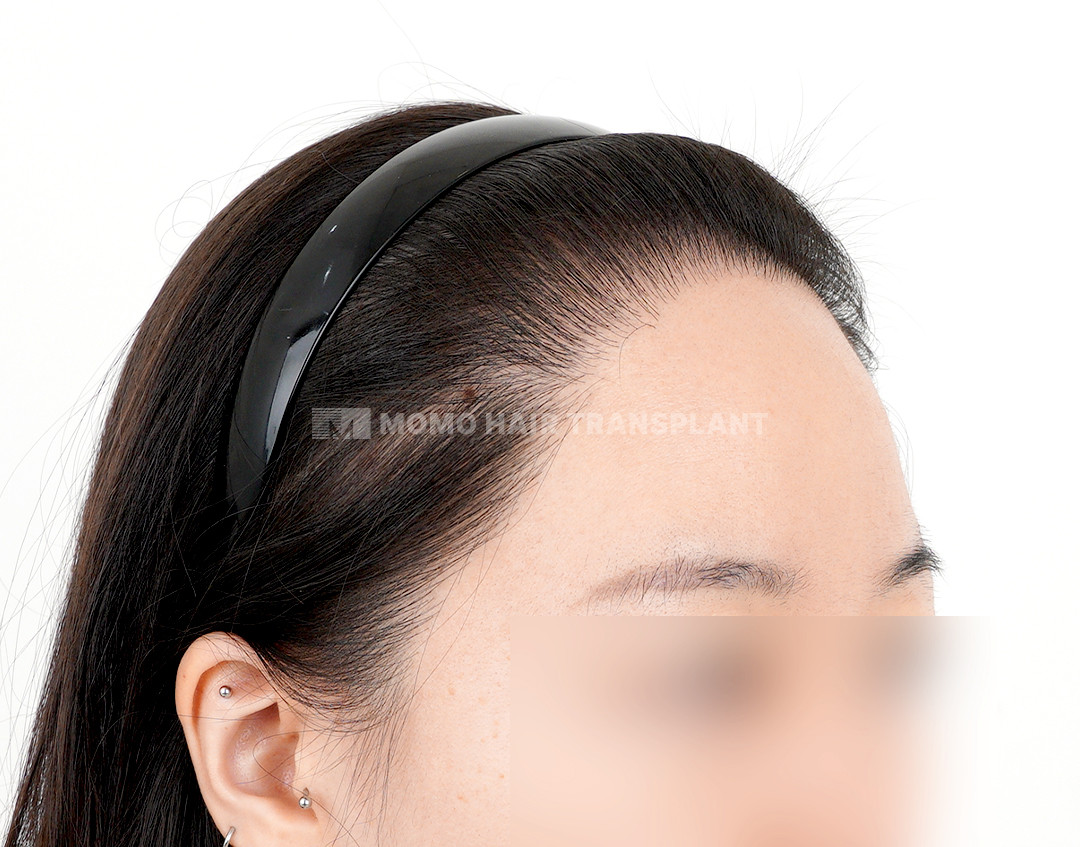 378 days after surgery
MOJELIM Plastic Surgery: planning the central hairline and temples separately
MOJELIM Plastic Surgery has a women’s hairline centre offering FUE and FUT. Planning is not simply about making the hairline lower: temple shape, hair calibre at the edge and growth direction also matter. Poor donor quality or progressive thinning calls for assessment of the underlying hair loss first.
Its women’s FUT approach describes selecting the width and length of the donor strip according to the planned transplant size and considering finer hairs for the leading edge. FUE harvests individual follicular units at scattered sites. Both require assessment of donor reserves. Unshaven or so-called non-incisional methods do not mean no scars or a guaranteed higher survival rate. Review frontal and oblique views and ask whether both temples are included in the treatment area and quote.
MOJELIM case 1: FUE hairline transplant, 3,400 hairs, 350 days after surgery
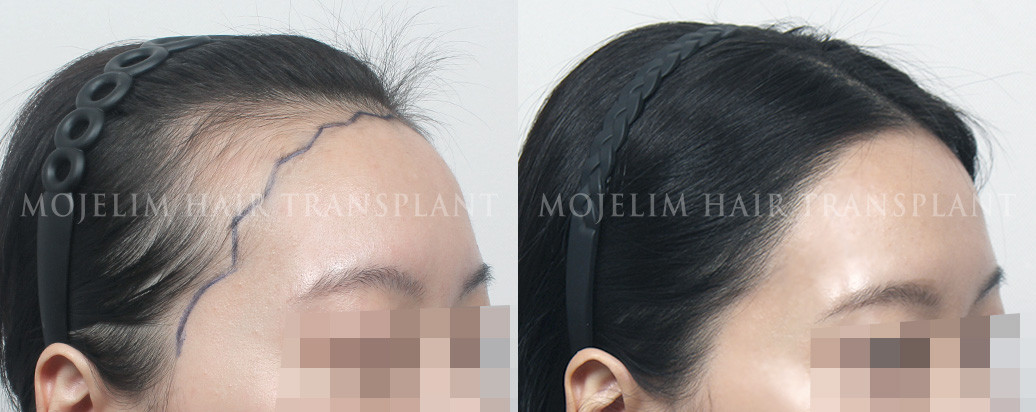
MOJELIM case 2: FUE hairline transplant, 2,000 hairs, 385 days after surgery
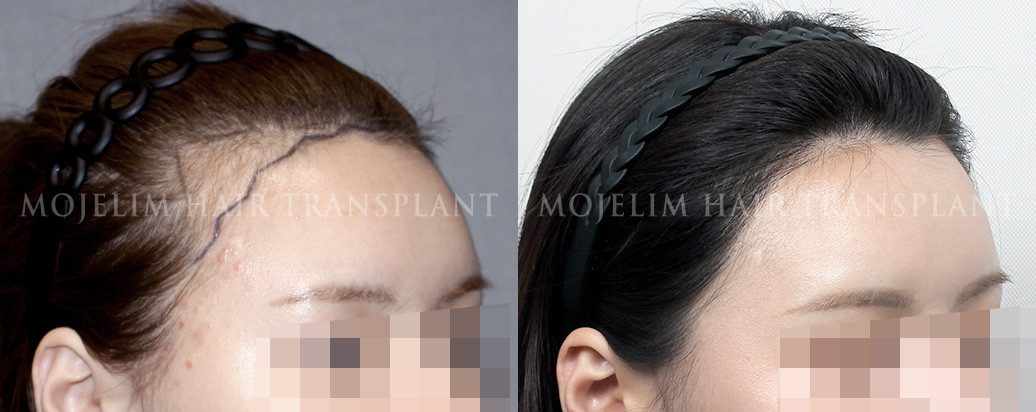
These are individual recovery photographs. Lighting, hairstyle and positioning can affect comparisons. Hair counts and follow-up intervals differ, so the photos cannot determine how many hairs you need or guarantee a similar result.
4. MULY: advancement, fixation and incision design in forehead reduction
MULY Plastic Surgery uses bone-tunnel suture fixation for forehead reduction: sutures secure the advanced scalp to bony anchoring points rather than an Endotine device. Its approach also describes a bevelled incision aligned with hair growth and protection of forehead sensory nerves. The fixation method does not eliminate scarring, hair loss or altered sensation.
Director Min Jang Hwan participated in a retrospective study of 91 forehead reductions using bone-tunnel fixation. At consultation, focus on how far your scalp can safely advance, how visible the incision may be when your hair is tied back, and whether previous hair transplantation, forehead surgery or scars affect the plan. Study results do not guarantee an individual outcome.
If the main concern is width at the temples, advancing the scalp alone may not address it; transplantation at the sides may also need assessment. If brow position is a concern, discuss forehead reduction and brow lifting separately before deciding whether a combined operation is appropriate.
MULY case 1: forehead reduction, 3 months after surgery

MULY case 2: forehead reduction, 6 months after surgery
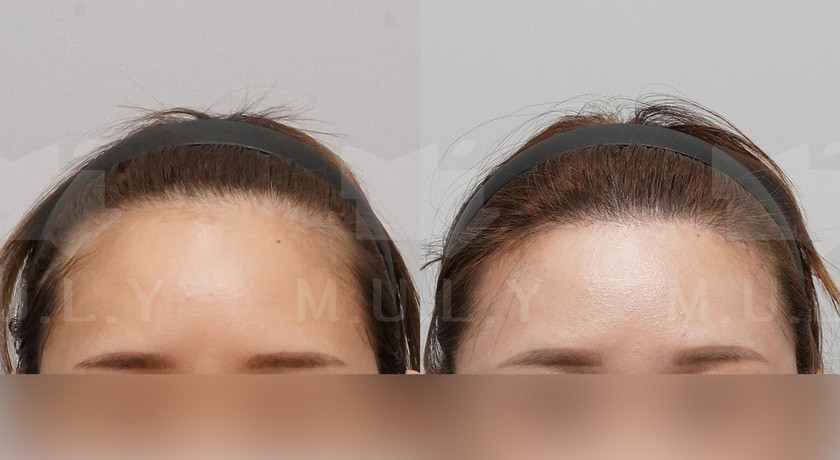
MULY case 3: forehead reduction, 3 months after surgery
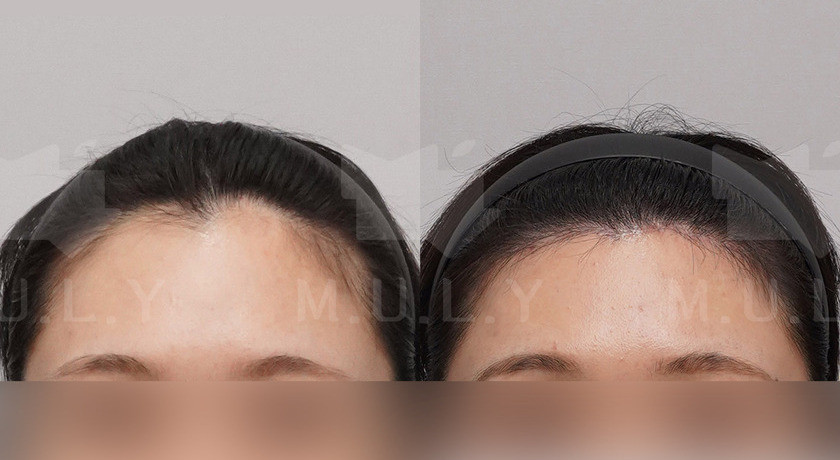
Look at the hair and skin around the incision as well as the hairline position. Photos of different patients at different stages are not a controlled comparison between clinics. Appearance several months after surgery does not replace assessment of sensation, wound healing and hair loss.
5. Costs: compare hair counts and the scope of surgery
MOMO and MOJELIM list transplant fees by number of hairs, not follicular units (FU). The selected pricing bands below are relevant to hairline planning. All amounts are in Korean won and include VAT; treatment materials and medication are also listed as included.
| Hair-count band | MOMO (Seoul) | MOJELIM |
|---|---|---|
| 1,000-hair band | 2.75–4.40 million | From 3 million |
| 2,000-hair band | 4.95–8.80 million | From 4.95 million |
| 3,000-hair band | 6.60–13.20 million | From 6.05 million |
These figures are budgeting references. Costs vary with the number of hairs, harvesting method and shaving arrangements. Women’s hairline procedures and treatment for overseas visitors are priced according to the individual plan.
For forehead reduction at MULY, allow approximately KRW 4.6 million as a budgeting guide. The final price may vary with taxes, current promotions and the surgical plan; use the quote confirmed when booking.
| Type of quote | Details to specify | Items often overlooked |
|---|---|---|
| Hairline transplantation | Frontal hairline and temple coverage; hairs or follicular units; FUE or FUT; shaving arrangements | Tests, anaesthesia, aftercare, medication, taxes and charges for additional transplantation |
| Forehead reduction | Primary or revision surgery; reduction alone or combined with a lift; fixation method | Tests, anaesthesia, suture removal, scar care and follow-up visits |
| Total travel budget | Keep medical fees separate from accommodation and transport | Booking deposit terms, a companion, flight changes and any extended stay for observation |
2,000 hairs are not the same as 2,000 follicular units. One follicular unit may contain more than one hair. The planned number should reflect the area needing coverage, existing density and donor supply; the budget should follow that assessment.
6. Risks to discuss before deciding
Hair transplantation can cause infection, bleeding, scarring, inadequate density, poor graft growth or an unnatural growth direction. Donor reserves are limited, so revision is not always a simple matter of adding more hair. For forehead reduction, discuss hairline scarring, hair loss near the incision, altered sensation, haematoma and possible revision. Avoiding a particular fixation device does not make surgery risk-free.
Contact the surgical team promptly for persistent bleeding, rapidly increasing swelling, worsening pain, fever or pus from the wound. Seek emergency care for breathing difficulty or other urgent symptoms. Do not try to manage problems with forceful massage, scalp pulling or extra medication on your own.
7. Recovery: waiting for hair growth versus wound healing
| Stage | Hairline transplantation | MULY forehead reduction follow-up |
|---|---|---|
| First few days | Protect the grafts and donor area. Wash as instructed; do not pick scabs or rub the area. | Monitor the incision, swelling and sensation, and attend scheduled aftercare visits. |
| About 1–2 weeks | Plan time off according to your appearance, work duties and recovery. | Suture removal is usually around day 8, with 2–3 clinic visits; the schedule is adjusted to wound healing. |
| Weeks to months | Transplanted hairs may shed before regrowing. Early shedding alone does not mean the transplant has failed. | The hairline has moved, but incision colour, tightness and sensation may continue to change. |
| Longer-term review | New growth takes months; assessment of the full result may take about 10–18 months. | Review scar maturation, hair around the incision and sensation—not just forehead height. |
Before leaving Korea, confirm wound review, washing instructions and travel arrangements. Having sutures removed does not mean you can immediately colour or perm your hair, tie it tightly or exercise strenuously. Your surgeon should advise when these activities can resume based on healing.
Frequently asked questions
If my hairline only recedes at the temples, must the whole hairline be lowered?
Not necessarily. If the central height is suitable, a design focused on the temples may be considered. Whether to lower the centre should depend on overall proportions, not a package name.
Does forehead reduction show a change sooner than a transplant?
The position usually changes sooner because existing hair-bearing scalp is moved. The incision, swelling and sensation still need time to recover. A transplant requires new hair growth, so the two procedures have different timelines.
Can I have a hair transplant after forehead reduction?
Some patients can later be assessed for grafting along the edge or temples once the wound is stable and donor and scar conditions are suitable. This cannot be guaranteed, and a second operation should not be treated as a reliable fix for an overly aggressive initial design.
Is FUT my only option if I do not want to shave my head?
No. Some FUE approaches allow partial shaving or no shaving. Suitability depends on the number needed, hair characteristics, technique and donor-area concealment. Include this in the consultation and quote.
Further reading and consultation preparation
Bring photos with your hair tied back and worn loose, a history of changes in hair loss, details of previous scalp or forehead surgery, and a list of current medications. Explain whether height, width or thinning matters most to you before discussing a plan.
Hair transplantation in Korea: FUE, FUT, hair counts and crown coverage · MOMO clinic information · MOJELIM clinic information · MULY clinic information
This article helps you prepare for consultation; it does not replace medical assessment of hair loss, donor supply or suitability for surgery. Individual case results are not guarantees.