
Korean clinics commonly call alar reduction “콧볼축소.” It is not one fixed operation: the width may come from a broad nostril sill, flared alae, or dynamic flare that appears mainly when smiling.
1. Broad nostrils, alar flare and a low tip are different
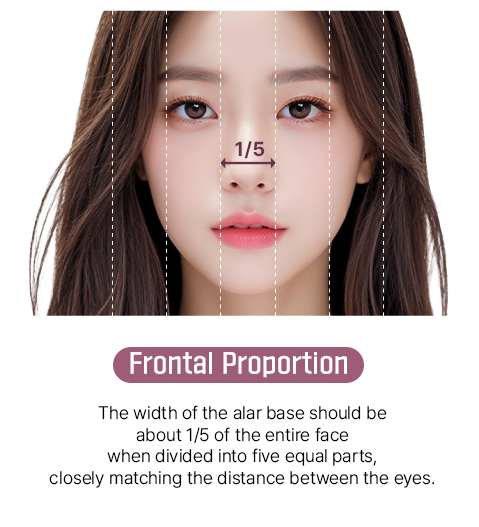
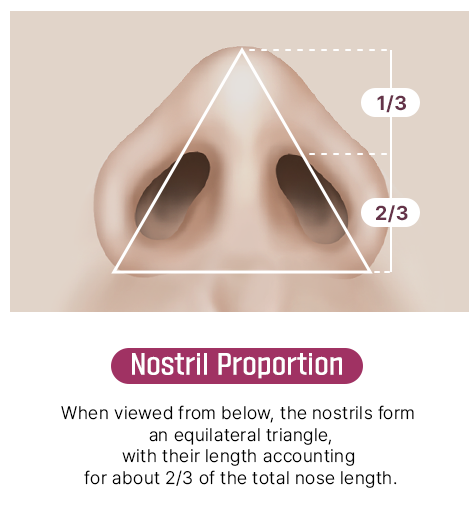
Assessment should include frontal, basal and smiling views. The frontal view checks alar-base width against the inner canthi and face width; the basal view checks nostril length, width and symmetry; smiling shows whether the flare is dynamic. Skin thickness, alar support and columellar relationships also guide technique.
2. Internal, external, combined or suture-only?
| Method | Main change | Incision / working area | Often discussed when |
|---|---|---|---|
| Internal excision | Narrows the inner nostril sill | Inside the nostril near the sill | The sill is broad but the outer ala is not thick |
| External excision | Reduces flare and some thickness | Natural alar-facial crease | The ala is clearly flared or thick |
| Combined excision | Treats sill width and flare together | Inner sill plus outer alar crease | Both the nostril opening and outer ala need adjustment |
| Suture-only / non-excisional | Draws both alar bases inward with sutures | Small punctures or intranasal fixation | Only mild narrowing is needed |
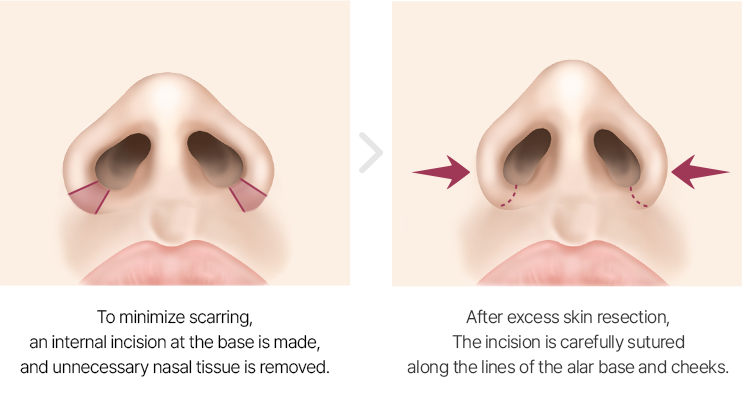
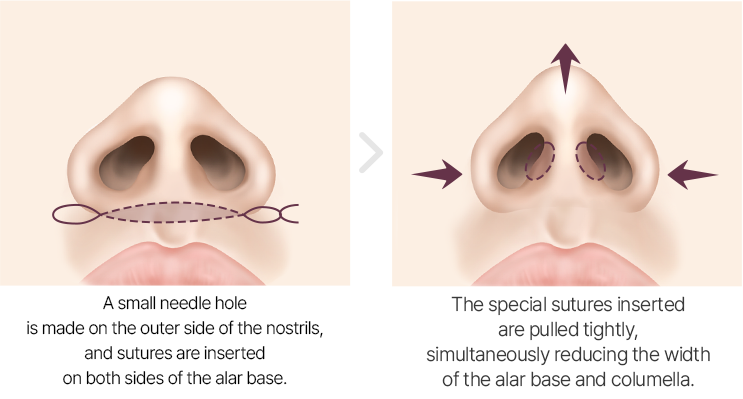
An internal incision is not right for everyone, and an external incision does not automatically mean a larger reduction. Ask whether the width comes from the sill, outer ala or tip, and whether the plan removes width, thickness or only uses fixation.
3. How much does alar reduction cost in Korea?
This is a public standalone reference price from a Korean rhinoplasty clinic. Tip, bridge, septal, revision or comprehensive rhinoplasty requires a new quote.
Confirm anaesthesia, 10% VAT, tests, suture removal, medication and scar-care charges.
4. Recovery planning
For standalone alar reduction, public clinic guidance commonly suggests 7–10 days in Korea; combined rhinoplasty often needs 10–14 days or longer. Obtain written cleaning, suture and follow-up instructions before leaving.
5. Eight questions to ask at consultation
- Is my concern a broad sill, flare, thick tissue or a low tip?
- Why do you recommend internal, external, combined or suture-only treatment?
- Will you remove width, thickness, or only use fixation?
- How will the nose change at rest and while smiling?
- Where will the incision run, and can the alar crease be preserved?
- How may my existing nostril asymmetry change?
- Should the tip be treated before deciding the final alar width?
- When can I remove sutures, wash, wear makeup, exercise and fly home?
Frequently asked questions
Does every wide alar base need reduction?
No. A low or broad tip can also make the base look wide, so combined planning may be more appropriate.
Does an internal incision guarantee no external scar?
The main incision is intranasal and less visible from the front, but it is still a surgical incision and may vary by plan.
Does external excision always reduce more?
It suits clear flare or thick tissue, but a natural result depends on preserving nostril curves, the alar crease and tip balance.
Suture-only or excision?
Sutures suit mild narrowing; excision can reduce width or thickness. The source of the width determines the choice.
How long should I stay in Korea?
Allow about 7–10 days for standalone surgery; external sutures are often removed around day 7. Combined rhinoplasty needs longer.
Based on verifiable Korean clinic information and medical literature checked in October 2026. It does not replace an in-person plastic-surgeon assessment. Images are clinic procedure diagrams.