 BeautsGo
If one side shows more gum when you smile and your chin deviates, should you reduce the larger jaw angle or consider double-jaw surgery? The decision depends on how the teeth meet, whether the upper jaw tilts or the lower jaw rotates, and whether the soft tissues are also asymmetric.
1. Three lines to assess at consultation
First, the level of the teeth when smiling. Unequal tooth or gum display may involve an occlusal cant, but lip movement, gum shape and head position can also contribute. Biting on a chopstick is not a reliable way to decide whether you need double-jaw surgery.
Second, the upper and lower dental midlines. The gap between the central incisors should be assessed against the facial midline, alongside crowding, missing teeth and tooth inclination. Teeth may compensate for skeletal asymmetry, so an apparently acceptable bite does not rule out a skeletal problem.
Third, the chin and mandibular borders. Chin deviation, unequal jaw angles and differences in soft-tissue thickness can coexist. Centering the chin does not necessarily level the bite; reducing the wider side does not correct rotation of the entire lower jaw.
Bring front, profile and smiling photographs in a natural head position, plus previous orthodontic and surgical records. Assessment should include jaw movement, bite and temporomandibular joints, with imaging, dental scans and orthodontic consultation when indicated. CT helps assess bone and nerves but cannot replace an oral examination.
2. Why four different situations call for different plans
| Main finding | What to discuss first | What cannot be assumed |
|---|---|---|
| Dental midline discrepancy or bite interference, with the lower jaw shifting on closure | Orthodontic and oral/maxillofacial assessment to distinguish dental, functional and skeletal causes | A chin photograph cannot determine a contouring plan; braces cannot correct every adult skeletal asymmetry |
| Acceptable bite and jaw positions, with differences mainly in the mandibular border or chin shape | Observation or targeted contouring/genioplasty | Reshaping the outer bone does not reposition the tooth-bearing segments |
| Marked lower-jaw deviation, while upper-jaw position and bite-plane orientation can be retained | Compare single-jaw and double-jaw plans after comprehensive assessment | A problem that looks confined to the lower face does not automatically suit single-jaw surgery; dental arches, joints and the resulting bite matter |
| Both jaws contribute, with marked occlusal cant or skeletal malocclusion | Orthodontics with orthognathic surgery, assessing movement and rotation of both jaws | Perfect symmetry of the lips, muscles and skin, or resolution of joint symptoms, cannot be guaranteed |
Progressive asymmetry, new bite changes, pain or limited mouth opening require investigation for joint or other disease. Sudden facial drooping, especially with slurred speech or limb weakness, needs emergency care rather than a cosmetic consultation.
3. What is actually moved when the face is realigned?
Double-jaw surgery usually involves cutting and repositioning both jaws, then securing them with fixation materials. Correction may involve vertical differences, rotation and front-to-back position as well as sideways movement. Every movement can affect tooth contact, so planning must be coordinated with orthodontics.
Ask the surgeon to show on a model or 3D plan: whether the upper jaw needs leveling, how the lower jaw will be aligned, whether separate chin surgery is needed, and what jaw-angle differences may remain. Double-jaw surgery plus three-area contouring is not a default package. If outer-contour changes are still desired, compare combined and staged treatment, including added risks and recovery demands.
Soft tissues do not always follow bone movement proportionally. Uneven lip levels, fullness or residual skeletal asymmetry may remain; relapse is another reason for long-term follow-up. A computer simulation is not a guaranteed result.
4. Real cases: identify the combined procedures before comparing appearances
Faceline: facial asymmetry and mandibular contouring

Check head position, chin position and both jaw borders before comparing the smile. Request cases with similar bite problems, the same procedure combination and longer follow-up, rather than choosing the most dramatic transformation.
Faceline: two male double-jaw cases

Because jaw-angle surgery was included, distinguish changes in chin position from changes in the outer jaw contour. The overall result cannot be attributed to double-jaw surgery alone.

This case helps illustrate facial-midline and lower-face proportions. Styling, expression and lighting differ between photographs, and frontal views cannot show tooth contacts. Oral photographs and imaging are still needed for consultation.
ID: double-jaw surgery with additional procedures, before and 3 months after


The changes cannot all be attributed to double-jaw surgery, and photographs cannot establish the original occlusal-cant diagnosis. Three months is not the final recovery point. No-Tie refers to avoiding postoperative fixation that binds the upper and lower teeth together; it does not mean no bone fixation, no orthodontics or no risk.
ID: No-Tie double-jaw surgery plus three-area facial contouring


The combined procedures differ from the previous case. Ask for each contouring component to be listed and what would remain if only orthognathic surgery were performed. A package name does not mean everyone needs the same combination.
1% Plastic Surgery: orthognathic surgery plus Bespoke Mini V-line, at 10 months
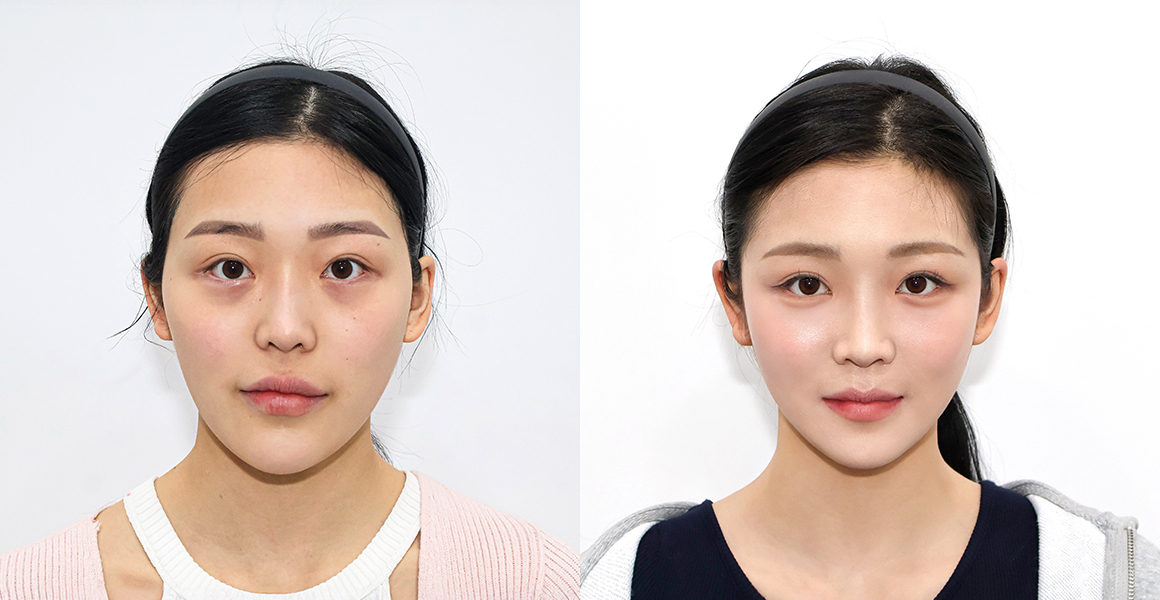
This combines jaw repositioning with lower-face contouring. The Mini V-line component concerns the chin contour; the exact bone-cutting range requires individual assessment. A 10-month photograph does not prove that orthodontics is complete or that relapse cannot occur.
1% Plastic Surgery: orthognathic surgery, cheekbone surgery and V-line, at 7 months
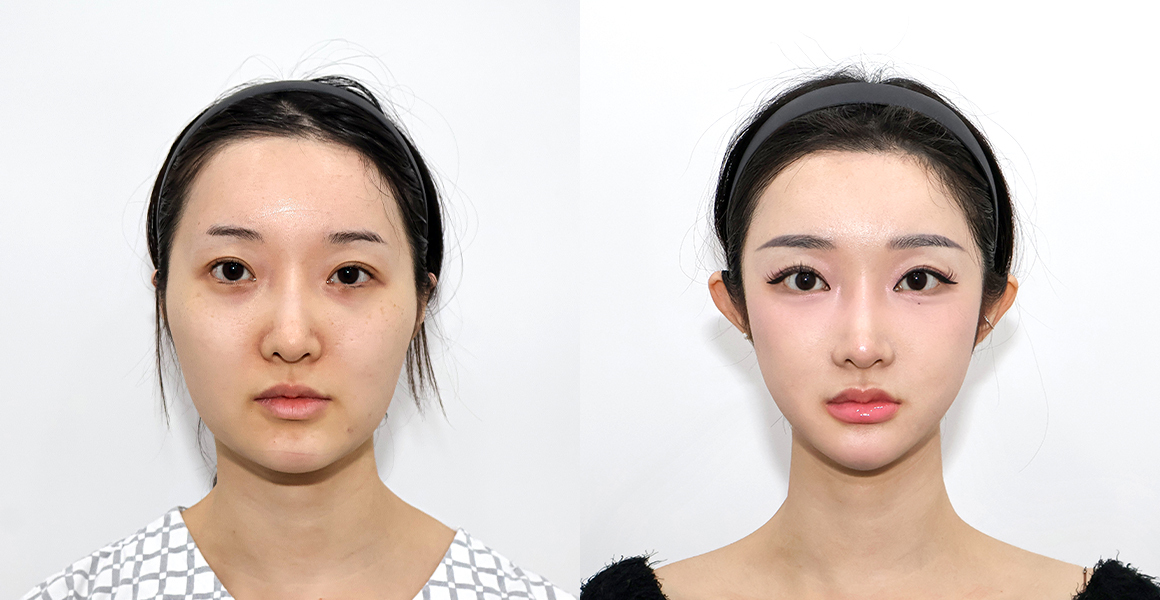
Cheekbone surgery is also included, so assess midface width separately from lower-face changes. High-3D is the clinic’s cheekbone procedure name, not another term for double-jaw surgery. Use combined cases to prepare questions, not to copy a procedure list.
ID: No-Tie double-jaw surgery plus eye-corner surgery, at 3 months


This case combines No-Tie double-jaw surgery with Dual Canthoplasty. Eye-area changes cannot be attributed to jaw surgery, and a centered chin does not prove that bite adjustment is complete.
1%: orthognathic surgery plus Bespoke Mini V-line, at 2 months

This is combined jaw and chin-contour surgery, not a chin-implant case. Swelling may still be resolving at 2 months; photographs cannot establish bone stability or final soft-tissue shape.
1%: combined jaw, facial-contour and submental soft-tissue surgery, at 3 months
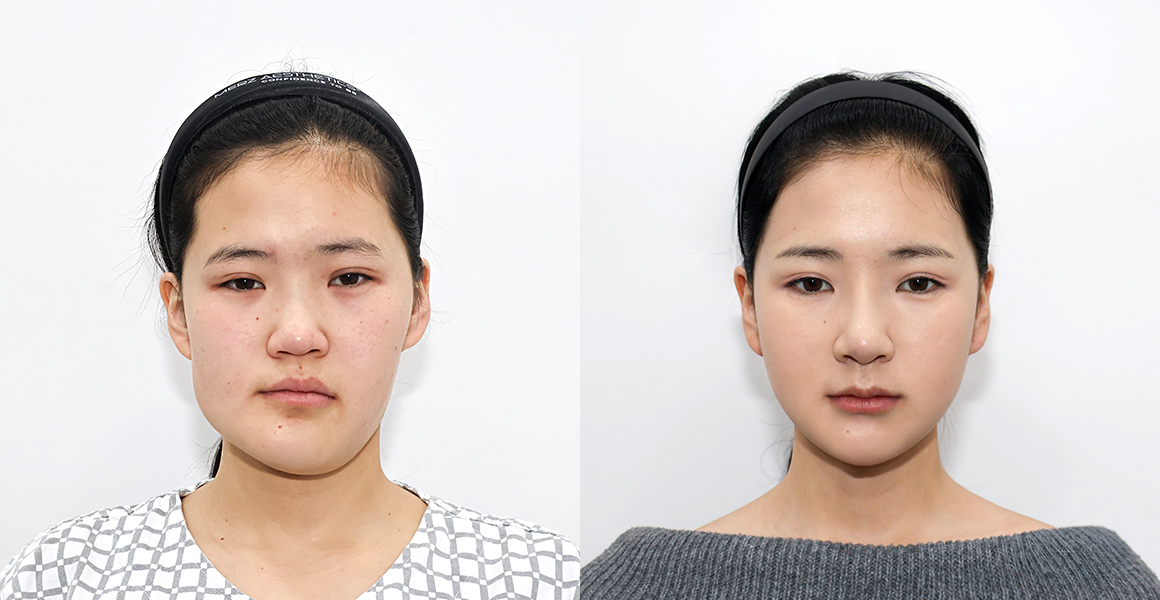
Submental soft-tissue treatment is included, so lower-face changes are not solely due to jaw rotation. If the tissues beneath your chin also concern you, discuss them separately rather than comparing only bone surgery.
5. Returning home, working and chewing hard foods have different timelines
| Stage | Planning for orthognathic treatment | Common misunderstanding |
|---|---|---|
| Before surgery | Complete assessments, orthodontic sequencing and arrangements for follow-up across countries; establish whether the teeth need preparation first | Surgery-first changes the sequence, not the need for orthodontic assessment |
| First few days after surgery | Hospital care or monitoring as directed for swelling, breathing, bleeding and eating; follow oral-hygiene, diet and medication instructions | Discharge does not mean you can immediately fly or recover without support |
| Around weeks 1–2 | Review wounds, bite and elastics/splints as directed; arrange soft foods and rest | Uneven swelling makes early symmetry judgments unreliable; do not adjust fixation aids yourself |
| Around weeks 3–6 and beyond | Resume work and diet gradually according to recovery; the surgeon determines bone-healing status and activity limits | Being able to work does not mean being ready for hard foods; reduced swelling does not prove bone stability |
| Following months | Continue orthodontic and maxillofacial follow-up for sensation, joints, soft tissues and stability | Short-term photographs do not establish the final result; sensation may recover more slowly |
This timeline is for orthognathic treatment, not isolated chin or contouring surgery. The surgeon should determine when you can travel. Persistent or increasing bleeding, breathing difficulty or swallowing difficulty needs immediate care; fever, worsening pain/swelling, abnormal discharge or sudden bite changes require prompt contact with the treating team.
For details on treatment order, read Double-jaw surgery: surgery first or orthodontics first?.
6. Compare the treatment scope behind the quote
Ask hospitals to quote from the same checklist before comparing totals. Chin surgery, jaw-angle contouring, single-jaw and double-jaw surgery have different scopes. Advertised starting prices may omit orthodontics and follow-up; use a written plan based on examination.
| Cost item | What the written quote should specify |
|---|---|
| Surgical scope | Whether one or both jaws move; whether genioplasty, cheekbone and jaw-angle procedures are included; primary or revision surgery |
| Tests and planning | Separate charges for CT, dental scans, models, splints and surgical guides |
| Orthodontics | Pre- and postoperative treatment, appliances, adjustment visits, retainers and transfer of care after returning home |
| Surgery and hospital care | General anesthesia, fixation materials, hospital days, postoperative tests, medication and nursing |
| Later treatment | Included follow-up, possible fixation-removal plans and fees, and arrangements for complications or revision |
| Tax and cross-border expenses | Tax, interpreting, extra accommodation, return trips to Korea and care in your home country |
You can ask: “My main concerns are a tilted bite when smiling and a deviated chin. Please explain the need for orthodontics, single- or double-jaw surgery, chin surgery and contouring separately, and list totals and exclusions.” For a combined quote, ask what would remain if one component were omitted, not just how much discount is available.
7. Choose a team that can locate the cause of your asymmetry
Faceline Plastic Surgery A consultation option for combined jaw and contouring plans. Ask whether the target is occlusal cant, lower-jaw rotation or outer contour, and distinguish procedures that affect the bite from those that change appearance.
ID Hospital Offers jaw and facial-bone treatment. Ask whether your teeth suit the proposed orthodontic sequence, how the bite will be managed after surgery and which reviews are needed before leaving Korea. Do not choose a plan solely because it is called No-Tie.
Confirm the actual surgeon, orthodontic partner and anesthesia arrangements. Joint disease, progressive asymmetry or complex revision needs appropriate diagnostic expertise. International patients should establish who will check the bite and handle emergencies at home, and obtain surgical, fixation-material and imaging records.
8. Frequently asked questions
Is reducing the larger side the simplest solution?
Targeted contouring may fit when the problem mainly concerns the outer bony border. If the bite plane or overall jaw position is abnormal, changing the outline alone may leave the main problem unresolved.
Will double-jaw surgery make the face perfectly symmetric?
No guarantee is possible. Bone, teeth, muscles and skin all contribute, and residual differences or relapse can occur. The aim is an individual improvement in function and appearance, not mirror-image symmetry.
Do the teeth need checking if the bite feels comfortable?
Yes. Teeth may have adapted to skeletal asymmetry. Comfortable eating or selfies cannot determine the need for surgery; mild, stable asymmetry may only need observation.
Bone-cutting procedures carry risks including bleeding, infection, anesthesia complications, tooth or nerve injury, altered sensation, bite problems, healing difficulties and relapse. This article helps prepare for consultation and does not replace examination or an individual treatment plan.